On a Tuesday evening, the owner of a three-chair dental practice posts in a Facebook group of practice owners: “Is there any software that sends appointment reminders by text and doesn’t cost $400 a month? We had five no-shows this week.” Within an hour, a dozen peers reply with the tools they use, what they pay and what annoys them about each one.
That thread is a buying decision happening in public. The problem, the budget, the alternatives and the switching criteria are all written down. Yet the founders who built those tools are usually not in the room. They are optimizing ads, posting on LinkedIn or waiting for inbound demos while their ideal customers compare software with each other on Facebook.
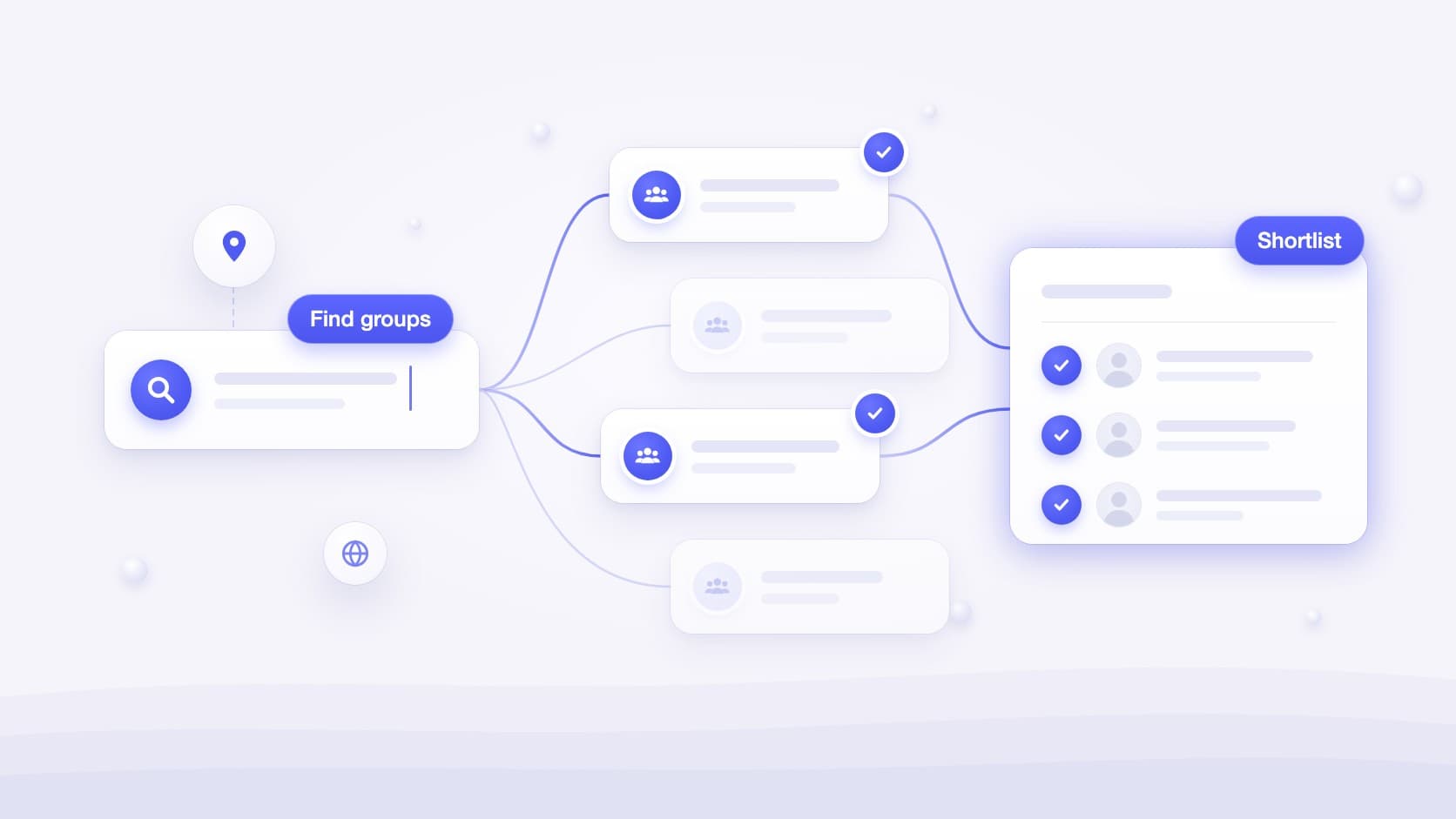
This playbook explains how to find SaaS customers in Facebook groups: which groups to choose, which buying signals to watch, how to reply as a transparent founder rather than a spammer, and how to turn a handful of good conversations into your first paying customers.
TL;DR
- Many SaaS buyers, especially in vertical markets, ask peers for software advice in Facebook groups rather than on Reddit or LinkedIn.
- Define one ideal customer profile first, then choose groups where that person talks shop: professional, tool user, competitor and operator communities.
- Watch for six signals: tool requests, “alternative to” posts, workflow pain, price or renewal frustration, integration needs and growth triggers.
- Answer the question first, disclose that you are the founder, and offer one low-friction next step. Never pitch with fake accounts.
- Measure the pipeline from relevant posts to paid conversions, and prune groups that produce nothing after a month.
Why Facebook groups still work for B2B SaaS
It is tempting to assume that software buyers live on LinkedIn, X or Reddit. Some do. But a large share of small-business software is bought by people whose job is not software: salon owners, dentists, contractors, property managers, coaches, bookkeepers, agency owners and e-commerce sellers. Many of them rely on Facebook groups built around their trade or their region to ask peers for advice.
Three things make these groups valuable for SaaS customer acquisition:
- Peer recommendations drive the decision. “What do you all use for…?” is one of the most common post formats in professional groups, and the replies form a live shortlist of competitors.
- Pain is described honestly. Members complain about workflows, prices and support in their own words, which is better market research than any survey.
- Switching moments are visible. Renewals, price increases, outages and team growth all trigger posts that reveal when a buyer is ready to change tools.
The channel has a well-known downside: self-promotion gets you removed. Quo (formerly OpenPhone) described joining and posting in dozens of groups during its beta. Some posts brought in more than a hundred beta users, while promotional ones got the founder removed from groups and temporarily banned. What worked better was offering value, including Q&A sessions with group admins. The rest of this playbook is built around that lesson.
Define your ideal customer before choosing groups
A vague target produces a vague group list. Before you search for a single group, write one ideal customer profile (ICP) that answers five questions:
- Role: who feels the pain and who signs off on the purchase?
- Company type: which industry, size and business model?
- Current solution: spreadsheets, paper, a legacy tool or a named competitor?
- Trigger: what event makes the problem urgent enough to change?
- Words: how do they describe the problem when they are not talking to a vendor?
The fifth question matters most for Facebook. Your customers will not write “looking for a patient engagement platform.” They will write “tired of calling every patient the day before.” Those phrases become your keywords later.
Choose groups where your users talk shop
SaaS customers gather in four kinds of Facebook groups. Each one produces different signals and requires a different level of caution.
| Group type | Typical members | Best signals | Caution |
|---|---|---|---|
| Vertical professional groups | Practice owners, agency owners, contractors, property managers | Workflow pain, tool requests, growth triggers | Often strict about vendors; read the rules |
| Tool and platform user groups | People using a platform your product integrates with | Integration needs, missing features, add-on requests | Official groups may ban third-party promotion |
| Competitor user communities | Current customers of a competing product | Price increases, outages, “alternative to” posts | Observe more than you post; never trash the competitor |
| Founder and operator groups | Startup founders, operations and marketing leads | Stack recommendations for horizontal tools | Crowded with vendors; quality varies widely |
Start with vertical professional groups if you build vertical SaaS, and with tool user groups if your product extends a platform. To build the shortlist, use the methods in how to find Facebook groups for your business or run your website through the free Facebook Group Finder, then vet each group’s activity and rules before you join.
Map the buying signals SaaS customers post
Most posts in a professional group are not buying signals. The ones that are tend to follow a small number of patterns. Map yours before you start monitoring so you know what deserves a reply.
| Signal | Example post | Keywords to monitor |
|---|---|---|
| Tool request | “What do you all use for client scheduling?” | what do you use for, recommend a software, any app for |
| Competitor switching | “Looking for an alternative to our current CRM before renewal.” | alternative to, switching from, [competitor] replacement |
| Workflow pain | “I spend every Friday copying invoices into a spreadsheet.” | spreadsheet, manually, takes hours |
| Price or renewal frustration | “They just raised prices again. Is anyone else leaving?” | price increase, too expensive, cancel |
| Integration need | “Does anything sync our booking tool with QuickBooks?” | integrate with, sync with, connect to |
| Growth trigger | “We just hired our third employee. How do you handle scheduling?” | just hired, outgrown, growing team |
Competitor and “alternative to” signals
Posts that name a competitor are the warmest SaaS leads in any group: the person already understands the category, has a budget and is actively comparing. Monitor each competitor’s name together with words like “alternative”, “switch”, “cancel”, “support” and “price”.
Reply with the comparison the person actually needs, including when the competitor is the better fit. Founders who say “for your size, their basic plan is probably enough” earn far more credibility than founders who attack every competitor in every thread.
Workflow pain signals
Workflow pain posts are the most numerous and the hardest to catch. The author often does not know that a software category exists for their problem, so they never use your category’s vocabulary. “I lose an hour every evening matching deposits to bookings” is a strong lead for a reconciliation tool, even though it contains no obvious product keyword.
These posts are also your best source of positioning. Save the exact phrases people use and reuse them on your landing pages, onboarding emails and sales calls.
Combine keywords and AI intent to catch indirect pain
Keyword alerts work well for tool requests and competitor names, because the vocabulary is predictable. They struggle with workflow pain, because there are endless ways to describe the same problem. The practical answer is a hybrid:
- Positive keywords for explicit requests, competitor names and integration terms.
- Negative keywords to exclude noise such as
hiring,job,for sale,affiliateand vendor announcements. - AI intent criteria that describe your ideal prospect in plain language, for example “a practice owner describing a manual, repetitive scheduling or reminder task they want to stop doing.”
The trade-offs are covered in keyword alerts vs AI intent matching, and our Facebook group keyword strategy guide shows how to build negative keyword lists that keep the feed readable.
Reply like an operator, not a vendor
A good founder reply reads like advice from an experienced peer who happens to have built a tool. Use this structure:
- Answer the question first. Give the most useful advice, even if it does not involve your product.
- Add context only you have. Share what you have seen across many customers with the same problem.
- Disclose your connection clearly. Say that you are the founder in the same comment, not only on your profile.
- Offer one low-friction next step. A template, a short checklist or a quick look at their setup, never a forced demo.
“Five no-shows in a week is painful. Two things that usually help: send the reminder 48 hours ahead instead of 24, and ask patients to reply C to confirm so your team only calls the ones who don’t.
Full disclosure, I’m the founder of a small reminder tool for independent practices, so I am biased. Several tools in this thread can do two-way confirmations, so check that feature whichever one you pick. Happy to share the reminder wording our customers use if that helps.”
This reply helps even if the practice owner never buys, which is exactly why it builds trust with everyone else reading the thread. For more on responding without sounding promotional, see how to find customers in Facebook groups.
From a comment to your first ten SaaS customers
Paul Graham’s essay “Do Things That Don’t Scale” argues that founders have to recruit their first users manually. Facebook groups are one of the few places where you can do that at the exact moment someone describes the problem. A typical path looks like this:
- Public answer. You help in the thread and disclose who you are.
- Permissioned conversation. The author replies, asks a question or accepts your offer to share something. Only then do you move to private messages.
- Discovery call, not demo. Spend fifteen minutes learning how they work today. You will learn more than you sell.
- Hands-on onboarding. Set the product up with them or for them. Early customers remember the founder who imported their data.
- Founding customer offer. Offer early access, a founding price or direct input on the roadmap in exchange for regular feedback.
- Referral to peers. Once they get value, ask whether anyone in their network has the same problem. Their recommendation in the group is worth more than any reply you write.
Expect a lot of churn between free interest and paid commitment. Quo reported growing its free beta to 1,400 users through Facebook marketing and word of mouth over five months, then converting 60 of them when it launched a $10-per-month plan. Interest from groups is real, but qualification and onboarding decide whether it turns into revenue.
Run a 30-day founder-led pilot
Treat Facebook groups as an experiment with a clear end date rather than an open-ended habit.
- Week 1, list and join. Write your ICP, shortlist 15 to 20 candidate groups, vet them and request to join the 8 to 10 best ones.
- Week 2, listen. Read without posting. Log the phrases members use for your problem, the tools they mention and the questions that recur.
- Week 3, monitor and reply. Turn those phrases into keywords and AI criteria, then reply to the two or three most relevant posts each day.
- Week 4, review. Count conversations, calls and signups by group. Keep the groups that produced conversations, replace the rest and refine your keywords.
Measure the pipeline, not the likes
Likes on a helpful comment feel good but say little about revenue. Track each stage of the pipeline per group so you can see where the channel actually works.
| Stage | Metric | How to track it |
|---|---|---|
| Signal | Relevant posts surfaced per week | Matches you would genuinely reply to, by group |
| Engagement | Helpful replies posted | A simple log with the post link and date |
| Conversation | Replies, questions and accepted offers | Mark each logged reply that led to a follow-up |
| Discovery | Calls booked | Booking form field: “Where did you hear about us?” |
| Activation | Trials or signups | Tagged links where group rules allow them |
| Revenue | Paid conversions and 90-day retention | Source recorded in your CRM or billing tool |
After a month, the numbers usually concentrate in a few groups. Spend more time there and drop the rest; a smaller list you follow closely beats a large one you skim.
Group rules, disclosure and privacy
- Group rules come first. Many professional groups restrict vendor posts to a weekly thread or ban links entirely. Follow them, and ask an admin when you are unsure.
- Disclose your connection. The FTC’s endorsement guidance says that people who promote their own company’s products on social media should disclose that relationship, and that listing the employer on a profile is not enough.
- Use one authentic identity. Meta’s policies prohibit inauthentic behavior and spam, including high-frequency posting and misleading people about who is behind an account.
- Respect members’ data. Do not export member lists, scrape profiles or add people to a mailing list because they commented in a group. Respond in context and let them choose the next step.
Frequently asked questions
Are Facebook groups good for B2B SaaS?
They work best for SaaS sold to small businesses and specific professions, whose buyers ask peers for software advice in trade and regional groups. They are weaker for enterprise software sold to large procurement teams.
How do I get my first 10 SaaS customers from Facebook groups?
Join a few groups where your ideal customer talks shop, watch for posts describing your problem, help publicly with clear disclosure, then offer a discovery call, hands-on onboarding and a founding customer offer to the people who respond.
Can I promote my SaaS in Facebook groups?
Only where the rules allow it. Many groups ban direct promotion but allow helpful replies with disclosure, or have a dedicated promotion day. Read the rules and ask an admin when in doubt.
Should I create my own Facebook group for my SaaS?
A user community can help retention and feedback once you have customers. Before that, your time is usually better spent in groups where your future customers already gather.
How do I find a competitor’s unhappy users ethically?
Monitor public conversations that mention the competitor with words like “alternative” or “price increase”, reply with an honest comparison, disclose your role and never misrepresent the competitor.
Are keywords enough, or do I need AI matching?
Keywords catch explicit requests and competitor names. AI matching helps with workflow pain described in unpredictable words. Many SaaS teams start with keywords and add AI criteria once they know which posts they miss.