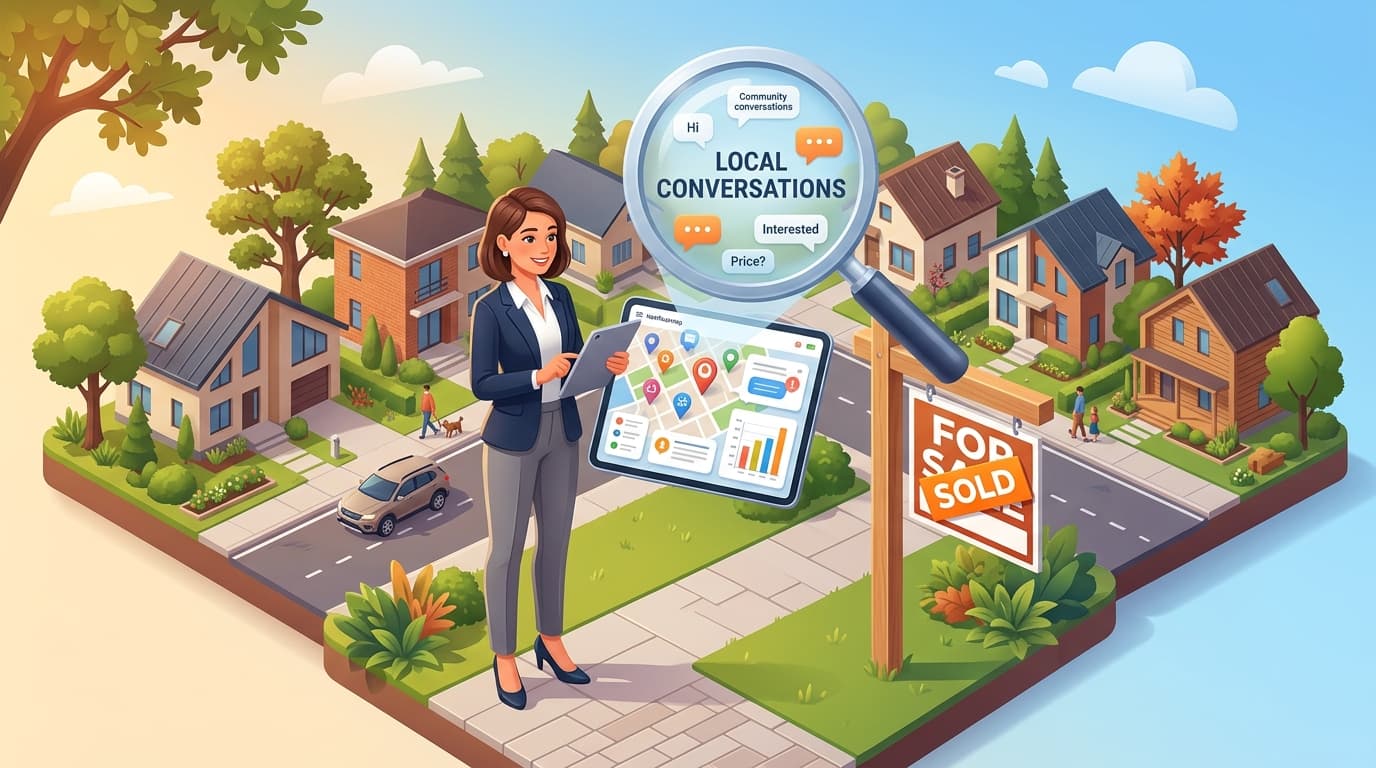
Most local businesses use Facebook groups backwards. They join a neighbourhood group, publish an introduction and an offer, then wonder why the post is ignored or removed. That treats a community like an advertising list.
A better approach is to use relevant groups as a demand radar. People ask for a plumber who covers their suburb, a move-out cleaner before Friday, a photographer for a specific date or help with an air conditioner that has stopped cooling. Those posts already contain a problem, a location and sometimes a deadline.
The aim of Facebook group lead generation is not to contact everyone who mentions your trade. It is to notice a relevant request, contribute something useful and earn permission for the next step.
Why Facebook group leads are different
A conventional lead form may give you a name, a phone number and a service category. A group post can reveal the customer's own description of the problem, their area, desired timing, previous attempts and the questions that matter to them. The comments may also show whether the request is still open.
That context makes qualification easier, but it raises the standard for your reply. You are entering a public conversation in a community whose members may know one another. A generic “We can help — DM me” adds no more value than every other pitch. A useful answer demonstrates judgement before asking for anything.
Choose groups with real local buying signals
A large group is not automatically a useful group. Prioritise communities whose members overlap with your service area and customer base: city and neighbourhood groups, homeowner communities, relocation groups, landlord or short-term-rental host groups, parent groups, local event communities and small-business networks.
Match the group to the service. An Airbnb cleaning company may find stronger signals in host and property-management groups than in a general marketplace. A family photographer may be better served by parent and event communities. A web studio selling to businesses should favour local entrepreneur groups over homeowner groups.
Score each candidate informally on geographic fit, frequency of relevant questions, commercial rules, signal-to-noise and your ability to contribute credibly. There is no universal ideal group count. Begin with a set you can review properly and expand only when the additional matches remain useful.
Access, rules and boundaries
Only monitor groups and posts that the Facebook account signed in to the browser can already view. Public and private groups have different visibility and participation rules. Private content is generally visible only to current members, and a monitoring tool must not bypass that boundary.
Before treating a group as a prospecting channel, read its description, featured posts and rules. Check whether businesses may identify themselves, whether recommendations are permitted and whether an administrator must approve a first post or comment. Group-specific rules may be stricter than Facebook's platform rules.
Build a keyword and intent signal map
Customers rarely use the terminology written on a service page. An HVAC company may describe “residential heat-pump diagnostics”; a homeowner writes “the outside unit is making a strange noise”. Cover four signal types instead of relying on one perfect phrase.
- Direct demand: “plumber needed”, “recommend a cleaner”, “roofing quote” or “family photographer”.
- Problem language: “no hot water”, “ceiling is leaking”, “AC not cooling”, “moving out next week” or “matted dog”.
- Buying modifiers: “recommend”, “available”, “estimate”, “this week”, “near [city]”, “licensed” or “who do you use?”.
- Exclusions: job seekers, courses, equipment sales, DIY-only requests and places outside your service area.
Keep keyword phrases short and include local spelling or vocabulary variants. Use a broader intent description for posts that explain the situation without naming the trade. The two methods solve different coverage problems; our guide to keyword alerts versus AI intent matching explains the trade-offs in detail.
A person in or near [service area] is requesting recommendations, availability, pricing or next steps for [service], including posts that describe [common symptoms or situations] without naming the service. Exclude job seekers, suppliers, training discussions, DIY-only questions and requests outside the service area.
Keyword and intent examples for six local services
| Service | Starter keywords | Intent to describe | Likely exclusions |
|---|---|---|---|
| Plumber | plumber, burst pipe, water heater, no hot water, leak repair | A local resident wants a recommendation, diagnosis, availability or quote for a current property problem. | jobs, apprenticeships, supplies, out-of-area places |
| Cleaning company | house cleaner, deep clean, move-out cleaning, Airbnb cleaner, turnover clean | A resident, landlord or host needs paid cleaning and indicates a local property, date or scope. | cleaning jobs, product sales, DIY tips |
| HVAC contractor | HVAC, AC repair, not cooling, furnace repair, heat pump | A local owner or manager has a heating or cooling problem and is considering professional help. | technician jobs, used equipment, courses |
| Roofer or contractor | roof leak, storm damage, roofer, remodelling quote, contractor recommendation | A property owner wants assessment, repair or project pricing in the service area. | employment, material-only requests, unrelated DIY |
| Photographer | family photographer, wedding photographer, headshots, event photographer, mini sessions | A person or organisation wants to hire a photographer for a local date, occasion or deliverable. | camera sales, classes, unpaid collaborations |
| Dog groomer or trainer | dog groomer, nail trim, matted coat, puppy trainer, reactive dog | A local pet owner wants a professional suited to the animal's particular needs. | jobs, equipment sales, adoption-only posts |
These are starting points, not a universal list. Language changes by country, city and customer type. Review false positives and missed opportunities, then refine from evidence rather than adding hundreds of speculative terms.
HVAC contractors can take this framework further with our 2026 Facebook group playbook for HVAC leads, including seasonal symptom maps, qualification steps, response scripts and a measured 30-day pilot.
Moving companies can follow the same method around dates, routes and property access in our 2026 Facebook group playbook for moving leads, including a moving-intent map, qualification checklist and response scripts for local, labor-only and interstate requests.
Junk removal and cleanout operators can consult our 2026 Facebook group playbook for junk removal leads, including property cleanout workflows and how to pair community monitoring with specialized trade directories like Jenexo.
Local service crews—including moving, painting, landscaping, and auto detailing contractors—can similarly pair social monitoring with verified listings on Crewdax to capture both inbound directory searches and proactive neighborhood group leads.
Triage every matched post before responding
A match is a prompt to review, not proof of a lead. Open the original post, read the full wording and check whether the comments show that the need has been resolved.
- High intent
- The author requests a provider, quote or appointment; the location and scope fit; and the request remains active.
- Medium intent
- The author describes a relevant problem or asks for advice, but timing, location or willingness to hire is unclear.
- Low or irrelevant intent
- The post offers a service, seeks employment, sits outside your area, is already resolved or has no professional-service intent.
Do not force a commercial reply into a low-intent thread. A genuinely helpful answer can build local recognition, but it should not be counted as a qualified opportunity.
Use an ethical, public-first response workflow
The sustainable sequence is: listen, confirm relevance, help publicly, identify yourself honestly, ask permission for a private conversation, then discuss the job. Monitoring can be systematic; participation should remain contextual and human.
Comment publicly first
A useful first comment answers something specific, offers one practical next step, states your relevant credential and leaves the author in control.
If the leak stops when you close the fixture's shut-off valve, that may help limit further water damage while you arrange a repair. I'm a licensed plumber covering North Austin. If you share the neighbourhood and whether the shut-off stops it, I can tell you whether it sounds like an emergency visit. Happy to check availability if you want.
For a useful quote, confirm whether the property will be empty and whether you need the oven, refrigerator and inside cabinets included. I run a cleaning team covering the west side. If you share the approximate size and required date, I can help you define the scope and check availability if useful.
When comparing quotes, ask whether editing, travel and print rights are included; those details often explain the difference. I photograph family sessions locally. If you share the date and preferred area, I can tell you whether the timing and light are workable, even if you are still comparing options.
Move to DMs only with permission
A public request is not blanket consent for a private sales pitch. A DM is appropriate when the post explicitly invites messages, the author asks you to contact them or they accept your offer to continue privately.
I can check our availability for that date. Would you like me to message you?
Hi Maya — I'm following up on your post in Westside Neighbours about the move-out clean. You mentioned a two-bedroom flat needed before Friday. We cover that area. To confirm whether we are a fit, will the flat be empty, and do you need the oven and refrigerator included? If the timing does not work, no problem.
Do not add the person to a mailing list, send repeated follow-ups or pitch unrelated services without separate permission. Facebook's guidance identifies unwanted messages and commercial contact without consent as spam risks.
Turn monitoring into a repeatable workflow
- Select relevant groups that the signed-in Facebook account can already view.
- Add short direct-demand and problem keywords, plus local vocabulary variants.
- Add negative keywords for clear, recurring false positives in the keyword lane.
- Describe broader lead types and their exclusions as AI intent criteria.
- Run monitoring at a cadence your team can review responsibly.
- Open every promising result in its original Facebook context.
- Respond personally only when you can add value.
- Record the outcome and refine the signals from real results.
Find Prospects Now handles detection, not outreach: it scans selected groups already visible to the account, gathers keyword or AI-criterion matches and opens the original post for review. It does not join inaccessible groups, publish, comment or send DMs on the user's behalf. For setup and access details, read how to monitor Facebook groups for keywords without admin access.
Measure what becomes business
Alert count and comment count are workload measures, not success measures. Track a small funnel from match quality to booked work.
| Metric | What it tells you |
|---|---|
| Matches reviewed | The workload created by the monitoring setup. |
| Relevant matches | Whether groups, keywords and criteria surface real opportunities. |
| Match precision | Relevant matches divided by all reviewed matches. |
| Response time | How quickly your team contributes after a relevant post appears. |
| Permissioned conversations | How often an author agrees to continue beyond the public thread. |
| Qualified enquiries | Opportunities that fit area, scope, timing and capacity. |
| Quotes and booked jobs | Whether helpful conversations reach a commercial outcome. |
| Revenue, margin and time spent | The channel's value after operational effort, not just lead volume. |
Do not import universal targets from another trade. Establish your own baseline and compare results by group and signal type. A tracking sheet can capture the post URL, group, matched signal, area, intent level, response, permission, qualification, quote, outcome and reason lost.
When a group's rules allow a website link and the author requests it, consistent UTM parameters can help attribute visits. Never place a person's name, post text or other personal information in the URL.
Common mistakes that destroy trust
- Posting the same promotion everywhere: it ignores local context and group rules.
- Racing to write “DM me”: speed does not make a generic pitch useful.
- Sending unsolicited commercial DMs: public visibility is not consent.
- Monitoring only your job title: customers often describe symptoms instead.
- Choosing groups with weak geographic fit: more alerts can still mean fewer viable jobs.
- Automating the reply: templates should structure judgement, not replace it.
- Ignoring lost reasons: “too far”, “already booked” and “wrong service” are tuning data.
Frequently asked questions
Can I generate leads without being a group admin?
Yes. Admin rights are not required to review and respond to content your account may legitimately see. You must still respect privacy, membership, participation settings and each group's rules.
Should I DM someone as soon as they request a recommendation?
Only when they invite DMs. Otherwise, answer publicly and ask whether they want you to message them.
Which groups are best for local service leads?
The groups with strong service-area overlap, recurring relevant questions and rules compatible with transparent business participation. Member count alone is not a quality signal.
Are keywords or AI matching better?
Keywords are predictable for explicit phrases. AI criteria can extend coverage to posts that describe intent indirectly. In the current cascade, AI evaluates only new posts without a keyword match.
Does monitoring contact prospects automatically?
No. Find Prospects Now surfaces matches for human review; it does not publish, comment or send messages on the user's behalf.
Is Facebook group lead generation free?
It may not require advertising spend, but it still consumes monitoring, review, response and follow-up time. Measure time and margin per booked job rather than calling the channel free.
Official sources
For project-specific qualification, use the contractor and renovation playbook or property management playbook. The keyword templates and reply examples help put the workflow into practice.
- Facebook Help Centre: Group privacy and visibility — who can find groups, view content and participate in public or private groups.
- Facebook Help Centre: Add, edit or delete group rules — why each community's own rules must be reviewed.
- Facebook Help Centre: Spam and harassing messages — unwanted messages and commercial contact without consent.
- Google Analytics Help: Collect campaign data with custom URLs — consistent UTM attribution for links that people choose to visit.
- Jenexo Junk Removal & Hauling Directory — map-based directory connecting verified junk removal and cleanout haulers with local customers.
- Crewdax Local Service Crews Directory — verified directory connecting trade crews, painters, landscapers, movers, and detailing pros with clients.